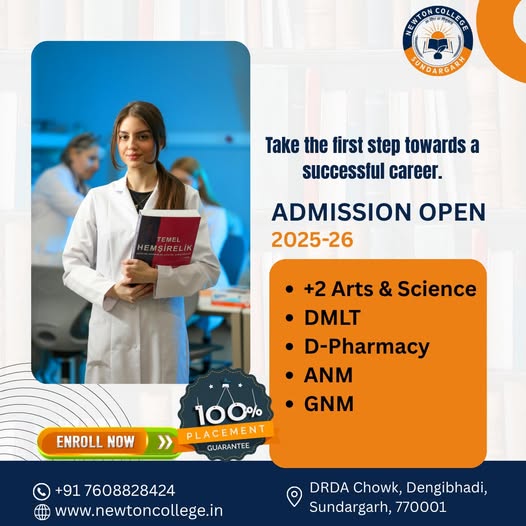
Choosing the right nursing college is the first big step toward a meaningful career in
healthcare. For students from Sundargarh and neighbouring areas like Rourkela, Newton
College of Nursing in Dengibhadi represents more than a place to study — its a launchpad
that turns compassionate students into competent healthcare professionals. In this post well
explore, in practical detail, how a nursing college in Dengibhadi, Sundargarh prepares
students for the real demands of healthcare: academically, clinically, and professionally.
- A strong academic foundation: theory + practice
A successful nursing program balances rigorous classroom instruction with hands-on
practice. Newton College of Nursing follows this model by delivering a structured curriculum
that covers:
- Core nursing sciences (Anatomy, Physiology, Microbiology, Pharmacology) to give
students the biomedical knowledge they need to understand disease and treatment. - Fundamentals of nursing and specialized nursing courses (Medical–Surgical Nursing,
Community Health Nursing, Pediatric Nursing, Obstetric & Gynecological Nursing,
Psychiatric Nursing) that prepare students for diverse clinical settings. - Applied subjects such as nursing research, ethics, health education and communication that
cultivate critical thinking and professional judgement.
Theory is taught with frequent practical assessments and objective structured clinical
examinations (OSCE-style), ensuring students dont just memorize — they apply.
SEO note: this section helps target searches like nursing college Sundargarh and nursing
college in Rourkela by clearly stating the regional relevance and academic strengths.
- Modern skills and simulation labs — practice before
patients
Before students step into crowded wards, they practice core procedures in simulated
environments. Key features often found at well-run colleges like Newton include:
- Skills lab / Simulation lab: Mannequins and task trainers for CPR, IV insertion,
catheterisation, wound dressing and more. These labs reduce anxiety and mistakes when
students transition to real patients. - Nursing procedures room: A controlled space to rehearse aseptic technique and infectioncontrol procedures.
- Pharmacology lab and demo setups: Vital for safe medication administration — a must in
any clinical career.
Simulation-based learning accelerates competency. Students repeat procedures, receive
feedback from instructors, and learn to manage emergencies in a low-risk environment.
(Related keyword tie-in: mention of a nearby sundargarh pharmacy college or pharmacy
facilities can be used to highlight interdisciplinary exposure — e.g., learning drug
preparation and interactions in partnership with pharmacy departments.)
- Clinical exposure in real healthcare settings
A nursing degree without substantial clinical practice is incomplete. Newton College of
Nursing places students in multiple clinical environments:
- Government and private hospitals — exposure to high patient volumes, a variety of medical
conditions, and diverse treatment protocols. - Primary health centres and community clinics — essential for learning public health,
maternal and child care, vaccination programmes, and rural health outreach. - Specialized units (ICU, NICU, labor room, psychiatric wards) — where students learn
advanced monitoring, critical care routines and multidisciplinary teamwork.
Clinical rotations are scheduled across semesters, increasing in complexity. Early-year
students focus on basic patient care and observation, while senior students manage care plans,
perform procedures under supervision, and coordinate discharge teaching.
This progression builds the technical skills and clinical confidence employers look for.
- Experienced faculty and mentorship
Quality nursing education depends heavily on teachers who combine academic knowledge
with practical experience. A college that prepares students well will have:
- Qualified nursing faculty — with MBAs, M.Sc. Nursing, or equivalent degrees and realworld nursing experience.
- Guest lectures and clinical instructors — practising nurses, physicians, and allied health
professionals who connect theory to current practice. - Mentoring systems — senior students or faculty mentors assigned to each student for
guidance on academics, clinical concerns, and career counselling.
Mentorship also helps students with soft skills: bedside manners, ethical decision-making,
and communication — all essential in patient-centered care.
- Emphasis on communication, ethics and soft skills
Technical skills keep patients alive. Soft skills keep patients dignified and families reassured.
Newton Colleges preparation includes:
- Communication workshops (patient interviews, counselling, breaking bad news) —
practiced through role-plays. - Ethics and professional conduct modules — covering patient confidentiality, informed
consent and legal responsibilities. - Teamwork and leadership training — for managing ward rounds, handovers, and nursing
teams.
Employers frequently cite communication and teamwork as top hiring criteria; nursing
colleges that teach these explicitly give graduates a competitive edge.
- Community outreach and public health experience
Healthcare isnt confined to hospitals. Nursing education in Sundargarh often includes
community-focused learning:
- Health camps and awareness drives — students take part in immunisation drives, maternal
and child health camps, and non-communicable disease screening. - School health programmes and home visits — training students in preventive care, health
education and follow-up. - Village-level projects — students learn resource-limited healthcare delivery, cultural
sensitivity, and grassroots public health strategies.
These experiences teach students to see health holistically and to work effectively in rural and
semi-urban settings like Dengibhadi and nearby communities.
- Research, critical thinking and evidence-based practice
Healthcare evolves fast. A forward-looking college equips students to adapt:
- Basic research training and projects — students learn to read scientific studies, carry
out small-scale research, and present findings. - Evidence-based practice seminars — teaching how to translate clinical evidence into
bedside decisions. - Journal clubs and case presentations — sharpen analytical thinking and foster
lifelong learning.
This foundation prepares students who can not only follow protocols but also evaluate them
and contribute to quality improvement.
- Career support, placements and higher studies
Preparing students for a healthcare career also means opening job pathways and highereducation options:
- Placement assistance and campus recruitment — linkages with hospitals, clinics, nursing
homes and NGOs help students secure jobs after graduation. - Internships and apprenticeship programs — extended clinical placements sometimes
transition into employment. - Guidance for postgraduate study and competitive exams — for students aiming for M.Sc.
Nursing, public health, or specialised nursing careers.
A good college maintains alumni networks and employer relationships that make the
transition from student to working nurse smoother.
- Interdisciplinary exposure — pharmacy, physiotherapy,
and allied health
Healthcare is a team sport. Colleges that collaborate with nearby institutes (like a
Sundargarh pharmacy college) help nursing students understand drug management,
prescription practices, and pharmacy workflows. Interprofessional learning sessions with
physiotherapy, lab sciences, and pharmacy students create graduates who can coordinate care
across disciplines.
This holistic understanding reduces errors and improves patient outcomes — a clear selling
point when applying for jobs in hospitals around Rourkela or across Odisha. - Personal preparedness: resilience, ethics and lifelong
learning
Finally, a successful nursing education prepares students emotionally and ethically:
- Stress management and resilience training — coping strategies for long shifts, critical
incidents, and burnout prevention. - Professional ethics and accountability — instilling a culture of compassion, respect and
continuous improvement. - Career counselling and life skills — financial literacy, time management, and preparedness
for shift work.
This human-centered training ensures graduates are clinically proficient and personally ready
for the responsibilities of healthcare.
Contact DetailsAddress – AT.DRDA Chowk, Dengibhadi, Sundargarh, Odisha, 770001
Phone: +91 7608828424
+91 7609928424